This blog was originally posted to my Substack account on May 29, 2026. The original post can be viewed here.
I’ve been dealing with some severe vertigo and migraine symptoms this month. It’s been hard to do very much, since I’m very light- and movement-sensitive, and straining my eyes has been giving me bad headaches. I’m often feeling caught between boredom, physical pain, and fear.
I hear about the political hellscape we’re in, and I want to do something to help, but I’m barely managing to keep myself fed and hydrated, get the laundry done, keep up with hygiene stuff, etc. I wish I could get out and do more things, but unfortunately, there’s a lot of lying in bed, thoughts racing, and trying to keep my facial muscles as relaxed as possible (it helps keep the migraines more manageable.)
As usual, when migraine symptoms get really bad, I’ve been occupying my time by listening to media. Whether that’s audiobooks, podcasts, or music, audible media gives me a way to keep my brain occupied without putting too much stress on my body.
In the past, I’ve used Audible to listen to audiobooks. I’ve been listening to audiobooks through Audible since I was in middle school, before they were bought out by Amazon. These days, I’m trying to reduce my reliance on Amazon products and services these days. Between the abhorrent working conditions at Amazon facilities, union busting activity, and the company’s shady practices to exert market dominance, reasons to avoid supporting Amazon are abundant.
I’m not pressuring myself to immediately cut Amazon out of my spending habits. They’ve very effectively ingrained themselves into my life, and attempted to make themselves indispensable. I have so many products on autoship, for example, that help me avoid constantly running out of the items that I need to keep myself going day-to-day (medications, accessible food items, hygiene items, cat litter, etc.).
I know that if I attempted to cut all Amazon products and services out of my life, all at once, the result would probably be utter chaos. Once the dopamine hit from the moral good wore off, odds are my self care strategies would collapse, and I’d go right back and sign up for my auto-deliveries again. So, the plan is slow and steady. Hopefully, slowly moving away from relying on Amazon will give me time to adjust, and build accessible and sustainable consumption habits moving forward.
This month, that looked like cancelling the Audible membership I’ve had for more than a decade, downloading the Libby app, and going to my local library to get a public library card.
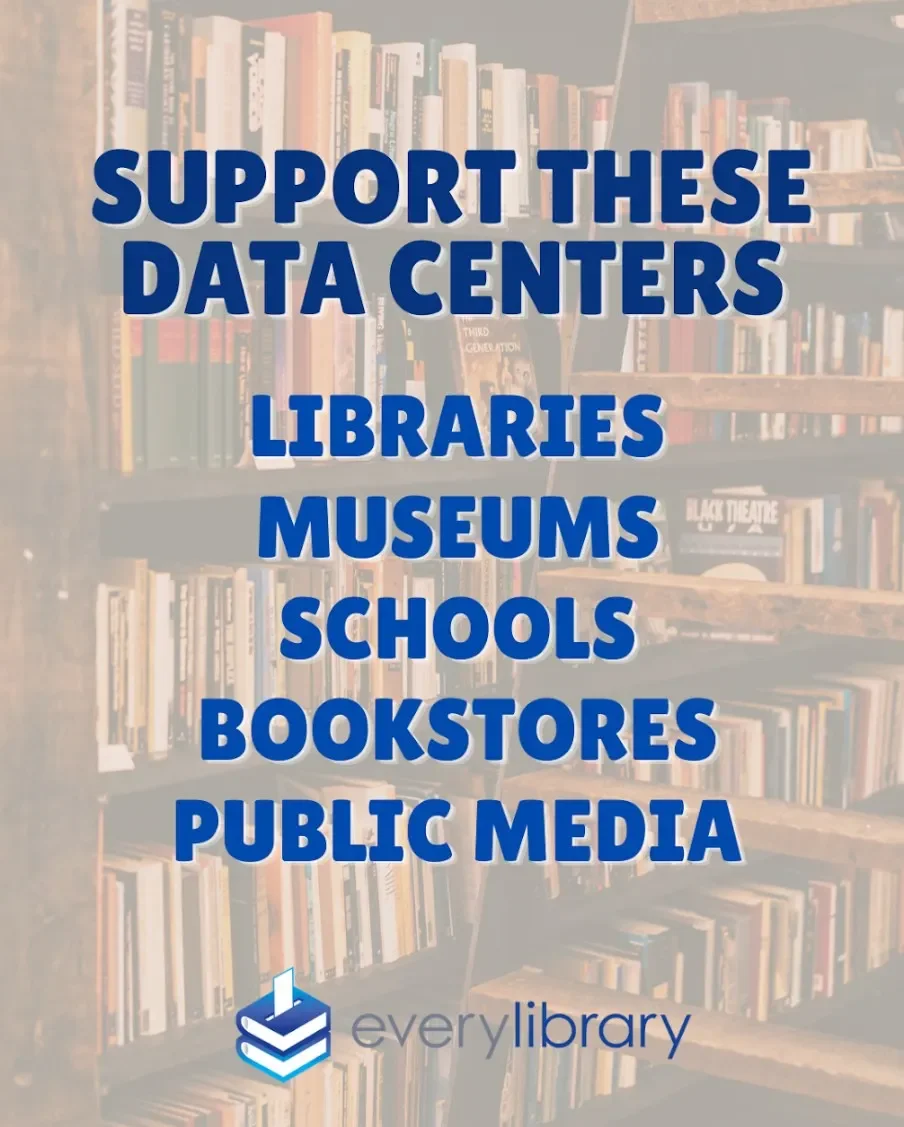
Source: EveryLibrary Facebook Page - see: https://action.everylibrary.org/
I have been listening to audiobooks non-stop, ever since. It’s been so easy, and I’ve loved having the freedom to jump around between titles more without committing to buying a specific book. I’ve really been enjoying it so far, so I wanted to take some time to let y’all know about my favorite books that I’ve been enjoying over the last few months since I got my shiny new library card.
Sunrise on the Reaping (2025)
Suzanne Collins
This is the latest prequel to the Hunger Games Trilogy, and follows Haymitch Abernathy’s experience as a tribute in the hunger games, 24 years before the initial hunger games novel is set. I’ve read all of the other books in this series (I love a good YA dystopian novel), and I really enjoyed this installment. It did make me cry more than any of the previous novels (which, unfortunately, made my migraine worse).
One of my favorite things about this installment was the fact that we (the audience) had received some information about these hunger games from other books in the series, and had a general idea of how those games played out. However, that narrative that we’d already been given was based on what aired on TV in Panem, and did not come directly from Haymitch himself. It was the “public version” of events.
Haymitch’s first person narration of the actual events in Sunrise on the Reaping is a welcome surprise, diverging from the previously described televised account, and providing a heartbreaking window into the personality of the decades-older Haymitch we see in the events of the main series. While it marks a flash to the past in the Hunger Games timeline, the novel is incredibly timely, focusing on how propaganda and governmental control of media impact the course of a revolution.
Red Clocks (2018)
Leni Zumas
I picked this book back up after a long hiatus. I started reading it a couple years ago, and had to put it down, because it hit a little too close to home. I’m so glad I came back to it now.
Red Clocks is a near-future speculative fiction novel set in a rural fishing town in the Pacific Northwest. Written before Roe v. Wade was overturned by the U.S. Supreme Court in June 2022, the novel is set in a dystopian near-future where “the Personhood Amendment” grants embryos and fetuses all the rights afforded to American citizens. Abortion and IVF are illegal in the U.S., and Canada is cooperating with the American Government to prevent (and subsequently punish) citizens who cross national borders to seek reproductive healthcare.
Set upon this backdrop, the novel follows four women living in rural Oregon, referring to them by their roles, rather their names. The Biographer is a high school history teacher who spends her spare time chronicling the life of a female arctic explorer of the 1800’s. She is unmarried, but wants to be a mother, and is attempting to conceive via IUI. The Daughter is a sixteen year old student of the biographer who finds herself unexpectedly pregnant, and seeking an abortion. The Wife is married (rather unhappily) to one of the biographer’s colleagues, and is the mother of two young children. The Mender is an herbalist who lives in the woods outside of town, and is widely regarded by community members as a witch. She comes under police suspicion after being accused of providing an abortion to a member of the community.
The book combines elements of dystopian and speculative fiction with mystery and courtroom drama, to tell the intertwining stories of these four women negotiating agency in a world that desperately wants to control them. The novel is often compared to Margaret Atwood’s The Handmaid’s Tale, but it is less overtly violent, and somehow entirely more terrifying for it. Several of the events of the novel, including the overturning of Roe v. Wade, and the defunding of public broadcasting, have happened since the book’s publication in 2022. The events don’t feel like a far off dystopian story. Rather, they feel just out of reach; possibly the stories of just a year or two in the future.
The immediacy of the novel could definitely make it a difficult read right now. If that doesn’t sound up your alley right now, don’t pick this one up. I talked about this one A LOT in therapy, but I don’t regret it for a minute. The ending is, if not happy, then at least hopeful, and the novel is engaging and beautifully written.
Honeysuckle (2026)
Bar Fridman-Tell
I found this novel while searching for books with themes related to nature, after enjoying several nonfiction books that blend information about nature and ecology with personal narrative (Forest Euphoria by Patricia Ononiwu Kaishian and Braiding Sweetgrass by Robin Wall Kimmerer, among others). The novel is a retelling of a Welsh myth that I was unfamiliar with, about Blodeuwedd, a woman constructed of magic and flowers.
The novel follows protagonists Rory and Daye. Rory is a young boy living in a fantasy version of Britain, where the boundary between science and magic is blurred. Rory and his older sister, Wynne, live together in an isolated country home, largely unsupervised and without parental figures. When Wynne grows older and becomes too busy with school to play with Rory all day, she uses her newfound knowledge to create a friend for him, a girl named Daye, woven out of flowers, and then animated with the power of words and intention.
Rory becomes the best of friends with Daye, and as the two grow up, and face the challenges of Daye’s ephemeral nature, the story transforms from a beautiful natural fairytale to a psychological horror. The novel contends with questions about what it means to be human, and the nature and meaning of consent, as well as the consequences of abandonment and isolation.
The dual-perspective narration is handled expertly, transitioning from primarily Rory’s perspective in the beginning, to primarily Daye’s perspective at the end. This reinforces the thematic and tonal shifts throughout the novel, highlighting the characters’ loss of innocence, and the transition of the protagonist role from one character to another.
The novel explores themes of sexual abuse and coercion, which can be triggering for many readers. Personally, I found that the novel provides a really valuable and nuanced depiction of the subtleties of violence and control in intimate relationships. It was painful to read, but also very validating, and the novel resolves in a way that felt liberatory and hopeful.
Bog Queen (2025)
Anna North
After the intense emotional tension of Honeysuckle, Bog Queen was a sigh of relief. This story retained the dual-perspective narration, multiple protagonists, and themes of nature and mystery that I enjoyed in Honeysuckle and Red Clocks, but felt like a lighter, more casual read.
The novel follows two interlocking narratives: one of a forensic anthropologist working the case of a mysteriously well preserved female body found in a bog near Ludlow, England, and one of a young woman, a Celtic Druid, living and working in Iron-Age Britain near the start of the Roman occupation. The narrative explores the process of determining the cause of death of the woman found in the bog, the fate of the young Druid as she navigates her political role under the shadow of the looming Roman conquest, and–in short, mysterious interludes–the perspective of the moss that makes up the bog itself.
In addition to enjoying the natural themes, historical setting, and forensic mystery I expected to find when I picked out this novel, I also enjoyed the autistic-coded narration from the novel’s protagonists. Both narrators struggle with the more political aspects of their respective roles, and express frustration and feeling like an outsider as their preference for directness over charisma inhibits their success in their work. While neither character is explicitly called autistic, as an autistic reader, I felt very emotionally connected to the characters. I think this connection between the two protagonists served the narrative as a whole. It helped the work feel cohesive, and bridged the 2,000-year gap in time between the settings and characters.
Well, those are the books I’ve read over the last few weeks! If any of them sound like they might be a good fit for you, I encourage you to stop by your local library and check them out.
I hope to keep on reading new audiobooks, so feel free to comment with any recommendations you may have. Hopefully, I’ll also have energy to make another blog post with my reflections on the books I’m reading.
I’m currently part-way through Eat the Ones You Love a queer body horror novel that seems like a dark riff off the musical Little Shop of Horrors. Look forward to a possible review in a future post! (Maybe. Essay topics and frequency are, as always, subject to where my brain is currently finding dopamine, and whether or not I can stare at a screen long enough to write a blog post.)
Sending good vibes, y’all!
