This blog was originally posted on my substack on January 2, 2026. The original post can be viewed here.
One of many hills I am prepared to die on is this: people don’t do things for no reason.
You may not think it’s a good reason. The person doing it might not even think it’s a good reason. They may not even know what the reason is.
But I’m willing to bet that somewhere, deep down, there’s a reason. There’s a “why.”
Today, I was rereading the essay I posted recently about the language we use to discuss coping mechanisms. There were so many ideas that came up for me while I was writing that piece, and the main one was something I find myself constantly wanting to hit folks over the head with (metaphorically) in my daily life.
Just a couple days ago, I was at the pharmacy, picking up a five day course of Ziprasidone, an antipsychotic meant to stop the endless migraine I’ve been suffering through for months now. (Fingers crossed that day five will do it, but at day four it’s only turned the volume down slightly from intolerable.)
I got to the pharmacy counter and saw that a line had formed, but I also knew I wasn’t going to be able to stand that long. The only open seat was snug between a cardboard display case, and another person. I grimaced, awkwardly sat down in the too-small space, and apologized to my neighbor not once, but twice, during the process.
They looked over at me. “Its ok. You don’t have to apologize.”
I smiled, sheepishly. “Thanks… it’s that whole being-socialized-to-apologize-for-existing-in-physical-space thing.”
They laughed, and we struck up a conversation. A few moments in, when I asked her how her day was going, she frowned. “Not great. I’ve been feeling really upset all day for no reason.”
The little pet-peeve alarm beeped in my head. It wanted this human to not feel the way I felt for so long, when I believed my feelings made no sense. When I thought of my desires, needs, experiences, and actions as inexplicable, it also became so easy for me to label them as bad, wrong, or shameful. And I did that. I dove into the self blame and shame. I lived in it for a long time. I’m only just recently fighting my way back up to dry land.
The energy from that fight—learning to understand why I do what I do, instead of leaning back on my old strategy of shrugging, and calling myself irrational—is still rushing through my veins. I’m in that fight. So, in the seat by the pharmacy counter, I mentally restrained myself from launching into an impassioned lecture.
“Maybe you don’t know why you’re upset yet, but that doesn’t necessarily mean there’s no reason.”
The person I was speaking to shrugged, and changed the subject. A few moments later, when they circled back around, they doubled down: “it’s just really frustrating when I feel this way and there is no reason for it at all!”
I nodded, sympathetically. “That sounds really hard.” (And I meant it. I’ve been there. It is really hard).
Sometimes you have to pick your battles. Very often, those battles don’t take place with strangers at the pharmacy while you’re picking up migraine meds.
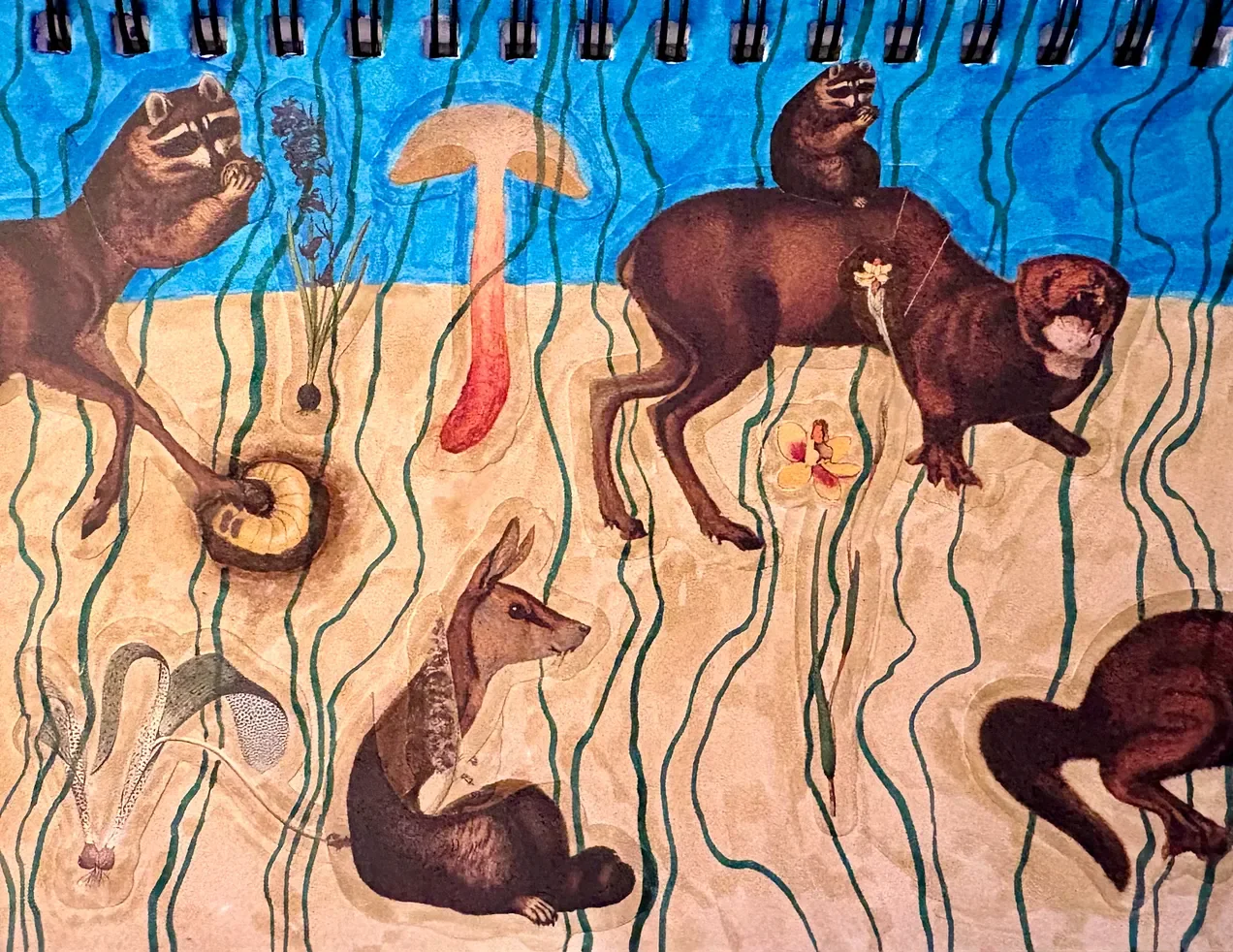
I created this piece for an expressive arts therapy course, in response to an art prompt where I was asked to engage in a guided mindfulness practice, and then make art based on the experience. Looking at it, you might have absolutely no idea what the “why” is, connecting my mindfulness practice and this image. But there is a “why” nonetheless. Was including this image a stretch? Probably. But it’s bizarre in a way that makes me really happy, so I wanted to share it.
But enough with the story. Aren’t some of you waiting for me to explain what I mean when I say there’s always a reason? Haven’t you also felt the agony of feeling like shit for no reason, and not knowing how to feel better? Or fucking up for no identifiable reason and having no idea how to repair your mistake? Or blowing up at someone who didn’t deserve it, and having no excuse? So, how can I say there’s always a reason?
Well, like I said, there’s a reason you feel like shit, even if you’re not consciously aware of it. Figuring it out might help you figure out how to feel better than you do right now.
And also, for the record, a reason isn’t the same thing as an excuse. Understanding why you blew up at someone doesn’t negate any of the fallout. Hurting someone is hurting someone, reason or no reason. But knowing the reason is the first step to not repeating the mistake again in the future, so it’s also a key part of accountability and growth.
Now, if you’ve got your hands over your eyes in frustration, screaming “yes I understand that you’re saying there’s always a reason, and that knowing the reason is helpful, but how the fuck am I supposed to come up with the reason??? That’s the whole point! I say there’s no reason because no matter how hard I look, I can’t find one!”
You’ve got me there. I can’t snap my fingers and make you see. Understanding the “why” behind people’s feelings and behaviors is something that takes a combination of skill and knowledge. Knowledge, in that it helps to have become aware of many examples of the “why” underlying different people’s behaviors. Experience, in that you need to get good at making educated guesses, and then changing your thinking as you get more data. You can recognize the common patterns, and you can sus out when people (including you) diverge from those patterns.
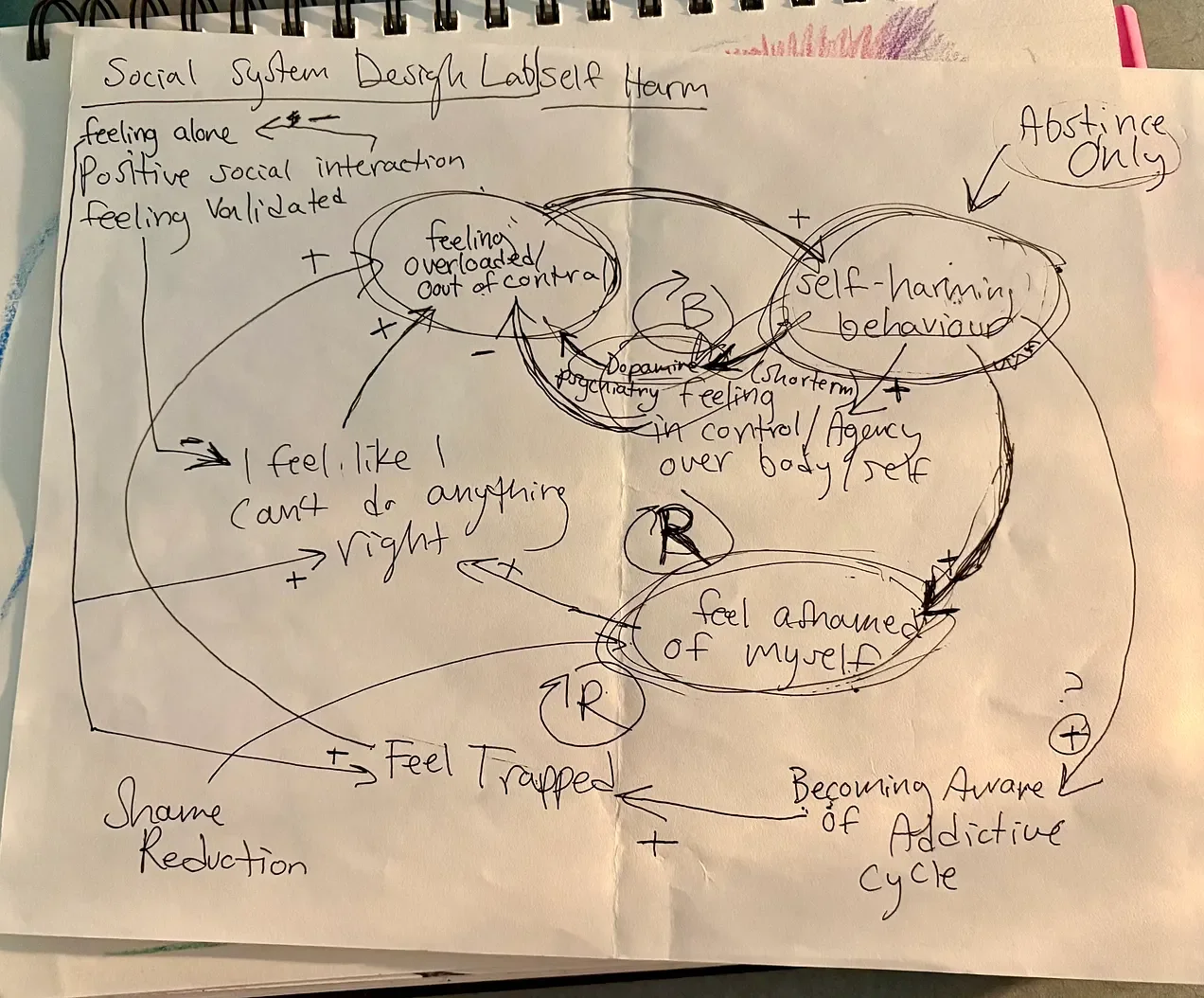
This is a (pretty rough) causal loop diagram, which is one of the tools I use to help folks (including myself) figure out the “why” behind their emotions and behaviors. Some day I hope to have the energy to write an essay walking through this mapping approach and showing how it can be used to both explain the nuances of counterintuitive behaviors, and how it can be used to help folks brainstorm solutions to help them meet their needs and their goals in creative ways.
I would start with the examples now, but unfortunately, my head is telling me it’s time to get off my phone, or else I’ll be in a world of hurt tomorrow.
But I hope to write a piece about core emotional needs sometime in the future, which should contain a lot of examples of why people feel what they feel and do what they do. I’ll hyperlink it to this paragraph when I do.
Anyone who is reading, thank you for coming along with me on this journey where I experiment with what it means to be a writer and a thinker in a body with dynamic disability. I’m living in a lot of uncertainty, and choosing to continue to share my writing even when I don’t have the energy to proofread, cite, polish, organize, and perfect it. It’s vulnerable to show up in public as my imperfect self, writing essays by hand, or voice memo, or text to speech. Having the space to do that, and even have a few folks reading what I share, is incredibly empowering.
Thank you. 💜
